Measurable Customer Service Goals with Examples

Customer service goals give support teams clear, measurable targets for improving the customer experience. They can focus on areas such as customer satisfaction, response times, resolution rates, customer effort and service quality.
The most effective customer service goals are specific, measurable and linked to wider business objectives. Below, you’ll find practical examples of measurable customer service goals, the metrics you can use to track them and how to set realistic goals for your team.
Examples of measurable customer service goals
Customer service goals should be specific enough to measure and closely linked to the experience you want to deliver. Here are some practical examples that you can adapt to your team:
- Improve first response time: Reduce first response time (FRT) from [xx] to [xxx] by [date].
- Improve resolution time: Resolve all customer service requests across all channels within 24 hours of receipt.
- Reduce repeat contacts: Reduce the number of repeat customer service calls within one month by 10% by [date].
- Improve customer satisfaction: Increase Customer Satisfaction Score (CSAT) by 10% by [date].
- Improve customer loyalty: Increase Net Promoter Score (NPS) by 5% by [date].
- Improve agent training: Ensure all new service agents achieve at least 80% in their post-training evaluation tests within six months.
- Reduce average handling time: Reduce average handling time (AHT) from [xx minutes] to [xxx minutes] by [date].
- Improve resolution rate: Increase the service call resolution rate from [xx] to [xxx] by [date].
- Improve first contact resolution: Increase first contact resolution (FCR) by 10% by [date].
- Reduce customer effort: Improve Customer Effort Score (CES) from [xx] to [xxx] by [date].
- Increase agent capacity: Increase the minimum number of customer interactions per agent per day from [xx] to [xxx] by [date].
- Improve out-of-hours support: Establish procedures by [date] for promptly dealing with customer service requests from customers in other time zones.
- Improve customer follow-up: Ensure every customer who contacts customer service receives a follow-up email after their issue is resolved, summarising the problem and how it was fixed. Implement this process by [date].
Why set customer service goals?
Well-planned and achievable customer service goals provide direction and make it clear what your team is working towards.
Goals focus attention on desired outcomes and give employees clear expectations. They can also help customer service teams connect their day-to-day work with wider business objectives.
Just as sales teams have targets that support business goals, customer service teams and individual agents need realistic targets that reflect the customer experience they are trying to deliver.
How to set SMART customer service goals
The SMART framework provides a useful way to define and evaluate customer service goals. A SMART customer service goal should be:
- Specific
- Measurable
- Attainable or achievable
- Relevant
- Time-bound
Being specific is important. A lack of specificity can result in confusion and make it difficult for teams to understand what they are expected to achieve. Specific goals should consider who is responsible, the resources required, the target, potential obstacles and the deadline.
A goal also needs to be measurable. This allows you to assess progress and determine whether the goal has ultimately been achieved.
Goals should be realistic enough to be attainable. Setting unrealistic or impossible targets can be demotivating, while achievable goals give customer service representatives something realistic to work towards.
Customer service goals should also be relevant to wider business objectives. Improving a customer service metric should ultimately contribute to a better customer experience or another meaningful business outcome.
Finally, every goal should be time-bound. Setting a deadline provides clarity and makes it easier to plan the steps required to reach the target.
For example, rather than setting a vague goal such as “Improve customer satisfaction”, a SMART customer service goal could be:
Increase our Customer Satisfaction Score (CSAT) from 82% to 88% by the end of Q2.
How to choose the right customer service goals
Start by examining the challenges your customers and service agents experience and how those challenges affect the wider business.
Common customer service challenges include:
- Customers having to re-explain their issues after being passed from one agent to another.
- Customers asking questions that agents cannot answer.
- Customers spending too long waiting for a response.
- Customers having to expend too much effort to resolve an issue.
- Agents not accurately understanding customer issues.
- Managing angry or dissatisfied customers.
- Understanding and meeting customer expectations.
Once you’ve identified the problem, choose a metric that can help you measure it. Establish your current performance as a baseline, decide what improvement would be realistic and set a timeframe for achieving it.
For example, if customers are waiting too long for an initial response, first response time (FRT) gives you a measurable starting point. You can then compare your current FRT with the level you want to achieve and set a deadline for reaching it.

Customer service goals for teams, agents and individual tickets
There doesn’t need to be one overarching customer service goal that applies to every member of the team. Different goals and metrics can be applied at team, agent and individual case or ticket level.
Team-level customer service metrics
- Average time to first response
- Average number of interactions per resolution
- Customer Satisfaction Score (CSAT)
- Average call handling time
- Customer request volume
- Overall resolution rate
Agent-level customer service metrics
- Resolved cases per agent over a given period
- Customer interactions per agent
- Customer satisfaction levels per agent
- Average handling time per agent
Case and ticket-level customer service metrics
- Number of new cases or tickets over a given period
- Number of cases or tickets related to specific topics, such as installation, upgrades or product support
- Number of cases from different geographic regions
Customer service metrics to use for your goals
The right metric depends on the customer service goal you’re trying to achieve. Some goals can simply be measured by whether a specific action has been completed by a deadline:
By [date], achieve [specific customer service outcome].
For goals focused on customer experience or service performance, there are several useful customer service metrics you can track:
| Metric | What it measures | Example customer service goal |
|---|---|---|
| Customer Satisfaction Score (CSAT) | How satisfied customers are with an interaction, service or experience. | Increase CSAT from 82% to 88% by the end of Q2. |
| Net Promoter Score (NPS) | How likely customers are to recommend your business. | Increase NPS by 5 points by the end of the year. |
| Customer Effort Score (CES) | How easy or difficult customers find an interaction or process. | Improve CES from [xx] to [xxx] by [date]. |
| First response time (FRT) | How long customers wait before receiving an initial response. | Reduce average FRT from two hours to one hour by [date]. |
| First contact resolution (FCR) | The percentage of customer issues resolved during the first contact. | Increase FCR from 70% to 80% by [date]. |
| Average handling time (AHT) | The average time spent handling a customer issue. | Reduce AHT from [xx] to [xxx] while maintaining customer satisfaction. |
| Resolution rate | The percentage of customer issues successfully resolved within a given period. | Increase the overall resolution rate from [xx]% to [xxx]% by [date]. |
CSAT, NPS and CES rely on collecting customer feedback directly. Customer Thermometer can help you collect customer feedback at key touchpoints, while operational measures such as FRT, FCR and AHT will typically come from your helpdesk or customer service platform.
Start measuring your customer service goals
Setting a customer service goal is only the first step. To understand whether the customer experience is actually improving, you need a reliable way to measure how customers feel.
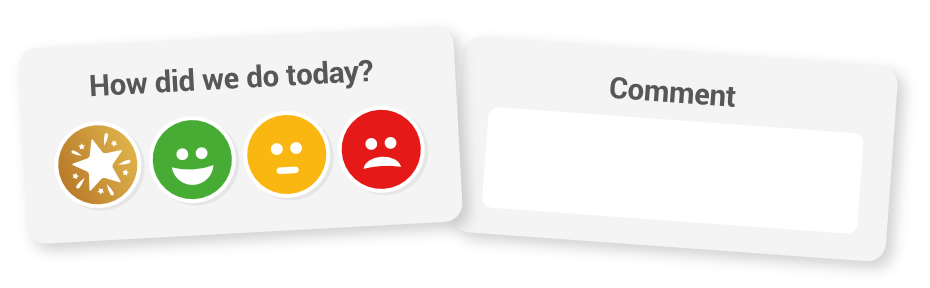
Customer Thermometer makes it easy to collect quick, one-click feedback at key customer service touchpoints, helping your team track customer satisfaction, identify issues and understand where action is needed.
Send yourself an example and see how one-click customer feedback works:
(Post last updated September 28, 2026)
By Lindsay Willott Updated